Tuesday, February 26, 2013

Occupations With Superstars


A few months ago, I blogged about how some people become superstars in their occupation by exploiting mass media and communications. For example, there are superstar chefs such as Emeril Lagasse, superstar doctors such as Sanjay Gupta, and superstar teachers such as Salman Khan.

In some occupations, however, it’s difficult to create a presence in the media or on the Internet that can lead to stardom. It’s unlikely that any TV news program will develop a segment on “welding news” and hire a welder to host it, no matter how telegenic and well-spoken some welders may be. The most popular instructional video about welding that I was able to find on YouTube has drawn 2.2 million hits, which sounds like a lot only until you compare it to some popular cat videos.

When I did the research for 250 Best-Paying Jobs, one question I investigated was which occupations offer the potential for superstardom. In this week’s blog, I’m reopening that question and basing my research on May 2011 salary estimates.

The way to identify occupations with superstars is to look at the difference between the mean earnings figure and the median figure. The mean is the algebraic average, so if the mean is a lot higher than the median, it means that a few star earners are pulling up the average. (They are doing the same thing that high-achieving students do to grades when they “ruin the curve” for average students.)

Here is an example that explains what I’m doing. Let’s say I’m looking at an occupation with only seven workers, and this is how their earnings are distributed:

Worker        Annual Earnings
A             $10,000
B             $20,000
C             $30,000
D             $40,000 (median: half earn more than D, half less)
E             $50,000
F             $60,000
G             $70,000

The median wage is $40,000, and if you do the math you’ll find that $40,000 is also the mean (average) wage. That makes sense because the wages are distributed very evenly here. But let’s say that worker G suddenly becomes a star and earns $400,000. The median does not change, but the mean now soars to $87,143. (That’s a difference of 118 percent.) Having a star earner in the mix of workers creates a big gap between the median and the mean.

So to compile the following list, I calculated the percentage difference between the mean and median wages of the occupations reported on in the Occupational Employment Statistics (OES) estimates for May 2011. The following list consists of those occupations with a difference greater than 25 percent.
It may not surprise you to find a number of occupations on the list that are related to entertainment, sports, or the media. Some of these unsurprising entries are Models (think of Tyra Banks), Radio and Television Announcers (think of Wolf Blitzer), and Broadcast News Analysts (think of Rush Limbaugh, if you must). Musicians, Singers, Actors, and Dancers would probably be on this list as well if annual wage figures were available.

But did you realize that some business occupations also have star earners? I believe that most of the business occupations that appear on this list have income that is based on who employs them. Those with superrich employers earn superstar wages.

This should be obvious with occupations such as Agents and Business Managers of Artists, Performers, and Athletes. A few agencies represent millionaire athletes and are able to pay their agents outstanding salaries, but most agencies represent clients with much more modest earnings. Something similar is true for Real Estate Brokers and Real Estate Sales Agents. Their earnings are based on a percentage of the price of the properties they sell, so those who handle expensive homes and high-ticket commercial properties earn sky-high commissions. Three more examples are Securities, Commodities, and Financial Services Sales Agents; Insurance Sales Agents; and Personal Financial Advisors.

What about Legislators? You may not know that there is enormous variation in the pay that these workers receive. In New York, they earn a median of $80,380, but the median ($19,360) is much more representative of what they earn in most other states. Of course, this low median figure doesn’t reflect the many lucrative lobbying jobs that lawmakers often cozy into after leaving public office.

I find it disturbing that the average difference (between median and mean) for all workers in all occupations is as high as 31 percent, especially considering that only 14 occupations have so large a difference. 

I looked at how this difference has changed since 2001, the earliest year for which I was able to obtain mean and median figures for all jobs in all occupations. Here the graph I generated.


You’ll notice that although both lines slope upward with the general modest inflation of wages, the mean increases at a faster rate, causing the gap between them to grow larger. Here is a graph of how that difference changes over those same years.
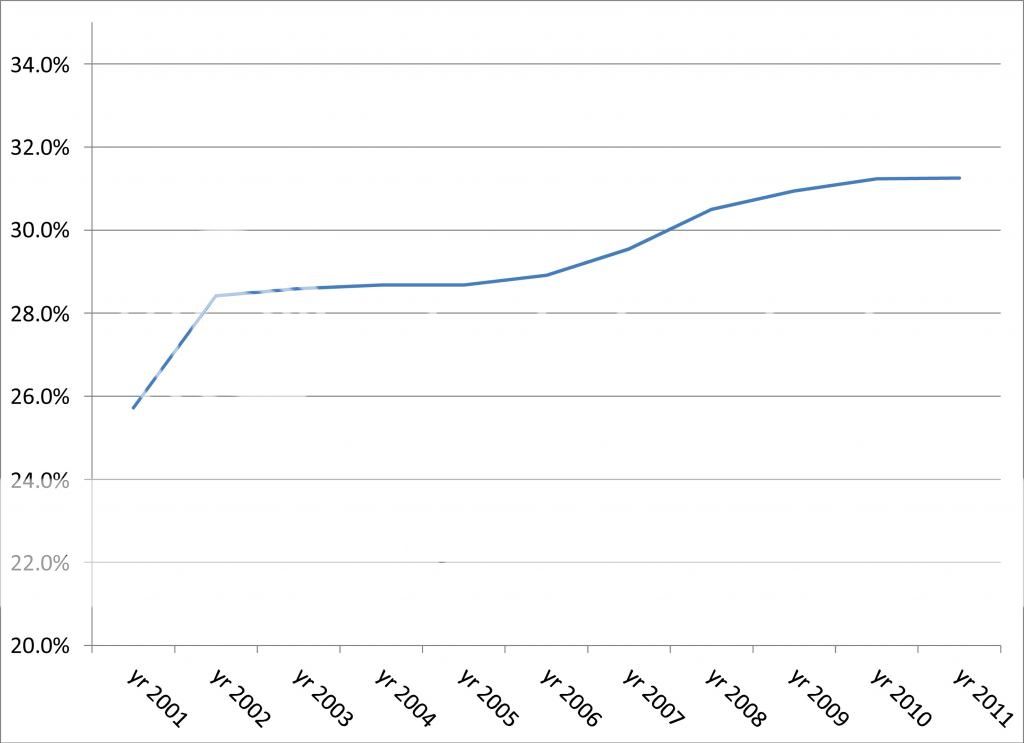

The present 31 percent difference is yet one more measure of the growing inequality in earnings that marks our present era as another Gilded Age. And, mind you, this difference is based solely on wages and salaries; it does not include the superstar earnings of those who are self-employed or whose earnings are disguised as capital gains.

Wednesday, February 20, 2013

Careers in Standards Enforcement

If you have worked in an industry for some time, you understand the difference between good work and hack work in your field. Perhaps you know harmful results that substandard business practices or products can produce. This knowledge can be the basis of your next job.

Some standards enforcers are essentially cops. They protect the public from illegal acts and harmful products such as hiring discrimination, air pollution, buildings that are firetraps, tainted food products, toxic paint on toys, and defective seatbelts. They conduct inspections, review records, perform tests, and take measurements that indicate compliance with the law or a violation. Like cops, they need to know the fine points of the laws that they are enforcing and the procedures for correcting or punishing those who violate those laws.

Some of these enforcers stay in one setting throughout the workday. For example, some equal opportunity representatives work in the human resources office of a large business and review the company’s hiring and promotion practices by checking records and interviewing staff. Other enforcement workers must travel between sites where they conduct inspections. Environmental compliance inspectors may take air or water samples at various locations; agricultural inspectors may visit several farms or food-processing plants in a workday.

Not all standards enforcers are responsible for upholding the law; some help a business to ensure the quality of its products or services. They make certain that your food will not make you sick, that your car will run properly, and that your pants will not split the first time you wear them. Management does not want to disappoint consumers, especially because news about schlock merchandise can spread quickly through social media and other channels. So quality-control workers sample the output and measure it against industry standards. When they find defects, they determine the cause. And they do more than just prevent substandard output. The current trend in management is to accomplish constant improvement of quality. So quality-control workers devise ways to exceed industry standards.

Maybe you’ve heard the joke about the guy whose job it is to sort potatoes into bags of small, medium, and large spuds. His complaint about the job: “Decisions, decisions!” What makes the joke funny is that the decisions the man must make, though unending, are really of very little consequence; great fortunes are not riding on his ability to make extremely precise judgments about potato size. In real-life jobs, however, enforcement of standards can sometimes have a very large impact. The impact can be beneficial, even life-saving. But it can also create conflict with the company or person whose output you judge as substandard. That’s one reason the decision-making aspect of the job can be stressful. Also, standards enforcers need to make their decisions within a structure of rules and procedures that sometimes can feel arbitrary and confining.

If you’re interested in doing this kind of work, relevant work experience may not be sufficient qualification; some law-enforcement jobs in this field require certification or licensure. Usually you must pass an exam that demonstrates your knowledge of the laws. You will face this requirement especially for jobs that relate to safety, such as construction and building inspectors. For some jobs, however, such as occupational health and safety specialists, licensing is uncommon and certification is voluntary. For these jobs, an appropriate education and work experience are more important.

People work in quality control at all levels, from the low-skilled potato sorters (who can easily be replaced by machines) to quality control systems managers and industrial engineers, who are highly skilled with using statistical techniques to create product-sampling schedules and to make sense of the data derived from them. These workers generally have at least a bachelor’s degree. Several organizations and universities offer graduate-level training that prepares you to pass a certification exam in quality control. Various kinds of science and engineering technicians, often with two-year degrees, support these workers.

There are formal and informal ways to move into standards enforcement. Think about who maintains the quality of output in your current job. Or consider who ensures the safety of your workplace or protects the environment in your community. Ask these people how they got their job and whether your experience in your work role would be helpful background to do this work.

If you’re aware of some aspect of quality control or safety that’s being neglected where you work (or at a similar workplace), maybe you can create a new job for yourself. Prepare a business plan for a program, with you in charge, that will address this need. Be sure to include estimates of the costs and, if possible, the payback to the company from increased sales or the smaller risk of a lawsuit. Then propose this plan to management. If you’re not knowledgeable enough to design and manage a quality control program, maybe you can convince management to bring in an appropriately qualified professional whom you can support as a technician.

Wednesday, February 13, 2013

A New Order in the Court?

The practice of law in America may soon undergo drastic changes. Early this month, the Law School Admissions Council reported that applications for law school were down 20 percent since the same time a year earlier. If this trend continues throughout the application season, the number of applicants will have fallen by 38 percent since 2010. Those who would have applied in previous years are finding other career paths to pursue, turned off by reports of unemployed law-school grads who are unable to pay off the huge debt they have run up in pursuit of the law degree. The American Bar Association found that only 55 percent of 2011 grads had landed full-time, long-term jobs as lawyers nine months after graduation. Only a dozen law schools, out of a total of 198, had a 2011 job-placement rate of better than 80 percent.

It seems likely that the tough job market for new lawyers will continue to get worse as computer technology advances. Computer programs are being used to do much of the research that lawyers used to do; these apps can rapidly chew through reams of documents to retrieve relevant information for purposes such as pre-trial discovery. Many consumers turn to services such as LegalZoom to create routine legal documents such as wills. And some legal research, contract negotiation, and intellectual property services are being offshored to low-wage countries such as India.

In response to this crisis in the profession, the American Bar Association created a task force to recommend changes to the system that educates lawyers, and it’s a measure of the seriousness of the situation that the commission seems likely to issue its report this fall, well in advance of the original deadline of the following summer.

Some of its possible suggestions are already being aired. Prominent among these is the idea of reducing the core of law school to two years from the current three to lessen the tuition debt that law students incur. Another tuition-saving idea is admitting college juniors directly into law school.

Ironically, at the same time that lawyers are not finding jobs, many Americans are having trouble getting legal aid to navigate the courts and have their rights represented. We are all entitled to a defense lawyer in a criminal case, whether or not we can pay for one, but no such public legal help is guaranteed in civil disputes such as evictions, divorce, and child custody cases. The problem is especially acute in immigration courts, where the availability of professional legal help is known to make a huge difference in outcomes.

So perhaps there is merit in one of the most radical ideas being discussed by the ABA task force: the creation of a new occupation, limited-license legal technicians. In practice, these workers would serve a role vis-à-vis lawyers roughly analogous to the role that advanced practice nurses play vis-à-vis physicians.
This occupation already exists in Washington State, where it was created by the state’s Supreme Court this past June. The occupation is regulated by a Limited License Legal Technician Board. The outlines of how the LLLTs are to be educated and what they will be allowed to do are specified in the Supreme Court’s ruling (PDF).

LLLTs will need to hold an associate or bachelor’s degree in an approved paralegal or legal assistant studies program, together with two years of work in this field. Alternatively, candidates for the license may hold a post-baccalaureate certificate from an approved program in the same field, together with three years of work experience. In both entry routes, at least one year of the work experience must be under the supervision of a Washington lawyer, and candidates must practice at least 20 hours of pro bono service in Washington within the two years before they take the licensing exam.

The work LLLTs do will be limited to civil proceedings. It will largely consist of selecting and completing court forms, informing clients of applicable procedures and time lines, reviewing and explaining pleadings, and identifying additional documents that may be needed in a court proceeding. The technicians will not be allowed to represent clients in court or act on the client’s behalf to contact or negotiate with opposing parties.

The amount of pay that LLLTs will earn is not, of course, something that the Supreme Court can specify. The job market will determine this. I’m curious to see whether the cost-benefit tradeoff for entering this occupation will prove more attractive than it presently does for attorneys.

Wednesday, February 6, 2013

In Praise of Mathematics

Mathematics was always my worst subject in school, but the more I learn about the working world, the more I appreciate it. I would advise any young person to study as much math as you can stand, and maybe even a little more. If you can’t stomach calculus, then take statistics. A lot of the really exciting work being done now involves new applications of math. And an ever-increasing number of careers are driven by data, so an understanding of data analysis keeps growing in value.

I remember that in the 1980s Brazil was thirsty for petroleum, so to avoid a gross trade imbalance that nation relied heavily on sugarcane-derived alcohol to power its cars. In 1980 Brazil produced only 182,000 barrels of petroleum. In 2011, however, production from offshore wells had boosted that figure to 2,105,000 barrels. Recently I learned that Brazil has been aware of the existence of offshore oil deposits for decades, but the petroleum is covered by a mile-thick layer of salt, and there used to be no way to determine the right places to drill. What made drilling feasible was the development of new algorithms that could make sense of seismic, magnetic, and gravitational data. In other words, math solved this problem.

Math also plays a role in the development of green energy resources. For example, wind turbines keep getting bigger in order to capture more wind energy, but blades as big as airplane wings create new problems, such as great differences between the wind conditions at the top and bottom of the blades’ sweep. General Electric has found ways to adjust the rotors to these conditions by using sophisticated algorithms that respond to input from various sensors.

“Big data” is another field with a growing need for people with math skills. IBM estimates that every day our economy generates 2.5 quintillion bytes of data, and that 90 percent of the world’s data has been generated in just the past two years. We refer to data analysis casually as “number crunching,” but what does this involve? The most obvious task is summary of large quantities of data. But even this task is multidimensional; you need to find ways to tease out not just the central tendencies, but also measures of variability at any one time and over time. And you have to find ways to ensure the accuracy of the data you’re getting, perhaps by drawing on redundant or divergent sources and finding ways to deal with the contradictions you uncover.

A few weeks ago I blogged about careers in analyzing medical data. The McKinsey Global Institute estimates the potential value of health-care data at more than $300 billion per year, two-thirds of which would result from reducing the nation’s health-care expenditures by about 8 percent. And that is just one field with potential for creating jobs for is big-data analysis. However, McKinsey projects a shortage of 140,000 to 190,000 workers to fill the big-data-crunching jobs that the U.S. economy could generate by 2018.

Over the course of my career, I have learned how to use Excel to do the computational heavy lifting, so it no longer matters that I had a hard time mastering the times tables in elementary school. The math skills I’m learning now are not so much computational as conceptual, such as how and why to use weighted samples. To a young person, I would suggest trying to see beyond computation and focusing instead on the underlying principles of data manipulation and analysis. Those skills can lead to a lifetime career of creative and productive work.

Wednesday, January 23, 2013

A Job Going Begging

Yesterday I received an unsolicited e-mail urging me to apply for a certain job opening. At first, I got a warm feeling. Even though I’m happy with my present job, it was encouraging to know that another employer considered me an attractive potential hire. However, once I started reading the message, I realized that the job in question was totally inappropriate for me. Nevertheless, the message also provided some interesting insights into the current job market.

The message began as follows: “I am [name withheld], Recruiter for a rapidly growing, community-based Regional Medical Center in Alamogordo, New Mexico. I came across your online resume, and would like to speak with you about our available Occupational Therapist position.”

In case you’re wondering, I am not an occupational therapist and never have been one. So why did I receive this unsolicited e-mail? The answer may be found in the recruiter’s statement “I came across your online resume.” My online resume contains the word “occupational” three times—all of them within the titles of books I have worked on: the Occupational Outlook Handbook, the Guide for Occupational Exploration, Third Edition, and the O*NET Dictionary of Occupational Titles, 2001-2002 Edition. In my LinkedIn profile, the word “occupational” appears five times—once in a book title and four times describing the contents of my books.

Evidently, this recruiter was employing an automated program. The searchbot scoured the Web for resumes containing the word “occupational,” harvested e-mail addresses from these resumes, and then generated an e-mail urging all of these potential recruits to get in touch. This searchbot (or the recruiter’s method of using it) apparently was not clever enough to look for the word “therapist” or “therapy” in the same resume, because otherwise I would not have been included in the e-mail blast.

I’m guessing that this error was unintentional—that the recruiter did not anticipate that the word “occupational” might appear on resumes in contexts other than occupational therapy. And, in fairness, I doubt that the searchbot harvested the e-mail addresses of a large number of occupational information workers, because there aren’t many of us. Also, consider that this error did not cause much trouble for the recruiter; those of us who received the message in error are unlikely to stuff her inbox with angry replies.

What else does this message tell me? It shows that, in this time of high unemployment, at least one job is going begging. And that’s not surprising, because this occupation is projected to grow by 33 percent between 2010 and 2020—much faster than average—and to create 5,710 job openings per year over this period. Several other health-care occupations have similar growth projections, but this one requires a master’s degree and therefore the pool of qualified applicants is small compared to, say, the pool of potential home health care aides.

There’s probably some significance that this job is in a small city: Alamogordo, New Mexico, population around 31,000. A famous dictum says that all politics is local. Not all jobs are local, when many can deliver a product or service from a remote location; however, almost all health-care jobs involving direct patient care are totally local. That’s one of the reasons they are growing even as many other jobs are being lost to overseas workers. But part of that job growth is in remote cities and towns that have trouble attracting new residents. I have never been to Alamogordo and cannot judge how good a place it is to live, but I can understand that its size and remote desert location might discourage some potential job applicants.

There are probably many other health-care jobs requiring advanced degrees that are going begging, so if you’re casting about for a career goal, give these occupations some consideration. And if you are an occupational therapist, enjoy small-city life, and are open to the idea of relocating to the Land of Enchantment, get in touch with me right away. I’ll forward to you the contact information for this job.

Thursday, January 17, 2013

Careers in Advocacy

Is there something you feel strongly about? Instead of just getting worked up about it, maybe you could do something about it. Your chances for making a difference are particularly good if you are well informed about the issue through work experience or have work-related skills that can help advance your pet cause. Have you thought about parlaying that work experience into a career in which you advocate for your favorite cause?

One way people create change is by changing the laws. In our political system, legislators do this. Legislators usually have a thorough understanding of the existing laws, and at least in one area of expertise. (They have legislative staff and lobbyists to inform them about other areas.) Because politics is the art of the possible, legislators generally construct new laws in ways that will build a consensus among their fellow legislators and the voting public. Often they work out the details in committee meetings and hearings that enable these stakeholders and others to offer their suggestions and buy into the proposed legislation.

Of course, politicians must answer to the opinions of voters. Similarly, businesses must answer to the preferences of consumers. Many professionals work in public relations to shape the attitudes that drive voting and purchasing behaviors. Public relations workers may create campaigns that advocate for change in the law, in government policy, and in corporate actions. Campaigns can be aimed at many kinds of behaviors—think of Smokey the Bear. Public relations workers may raise funds for research, a candidate’s political advertising, a university, or a public facility such as a museum or monument. They may work as lobbyists, communicating their talking points directly to legislators.

Another way to achieve change is through existing laws. You can work to compel the enforcement of laws that are being neglected or are being enforced too narrowly. Or you can compel a person, company, or even a government agency to change its behavior by suing for damages. Our democracy allows any citizen to petition an agency or file a legal brief, but lawyers are the workers who make a career out of this kind of action. They are assisted by paralegals and law clerks.

Yet one more way to work for change is through the media. Journalists and news analysts often arouse public interest in political, social, cultural, and business issues. Recently, some bloggers have become as influential as workers in the more traditional media. Speechwriters also communicate opinions. Although someone else serves as the writer’s mouthpiece and usually has considerable control over the content, you can choose to work for someone whose outlook you share.

Advocates work under some pressure, but they make many independent decisions. Not all of their efforts succeed in advancing the causes they care about, and sometimes they confront people who disagree strongly. Nevertheless, they enjoy the rewards of at least trying to make a difference.

Politics and other advocacy careers offer many opportunities for gaining experience through volunteer work. Find a local organization that works for the cause that motivates you and offer your services. If no such organization exists, start one. Advocacy groups need all kinds of volunteer workers, but if you’re interested in a career in advocacy, you should play a role that gives you appropriate experience. For example, you could write position papers and press releases, research legal issues, speak at public meetings, arrange meetings with legislators, manage a fund drive, or canvass voters.

Many people who work in advocacy leverage the knowledge that they have acquired in a previous occupation. For example, President Barack Obama entered politics after working as a lawyer and law professor, but he was greatly influenced by his earlier work as a community organizer. That experience educated him about the needs of working people and how politics operates at the grassroots level. Former Representative Tom DeLay of Texas earned a bachelor’s degree in biology, worked for a pesticide manufacturer, and then started a highly successful extermination business. When the Environmental Protection Agency banned a pesticide that was in wide use, DeLay decided to advocate for reducing government regulation of businesses. He volunteered as a Republican precinct chairman and eventually ran for a seat in the Texas legislature, which was his springboard to Congress.

Because it is a way to use knowledge from a previous occupation, advocacy is one of the career fields I discuss in The Sequel: How to Change Your Career Without Starting Over. Is there some issue that you have become informed and opinionated about through your work? Maybe you can advocate for it.

Wednesday, December 26, 2012

Do Robots Dream of Electronic Paychecks?

This week, I’m going to continue my year-end tradition of looking back at the tweets I’ve issued on Twitter in order to follow up on some and comment on the significance of others. (If you’re not already following me, my handle is @LaurenceShatkin.) But this week, I’m going to focus on a single trend that I’ve tweeted about numerous times: the growing use of robots.

In fact, if it were up to me to choose Time’s Person of the Year, I’d choose the robot. For example, this year I learned about a new trend in warehouses: using robots to pull merchandise off the shelves and bring it to the loading dock. Human forklift operators need not apply for these jobs. Robots are also threatening some jobs in the green career field of solar panel installation. Part of the reason this trend is accelerating is that technology is creating a generation of robots that are more deft and therefore more capable of doing work that until now has been done by hand. (“Fine motor control” takes on a different meaning when it refers to actual motors.) For example, a Philips Electronics factory in Holland is using robots to do the same delicate work—assembling electric shavers—that humans are doing in a Philips factory located in the Chinese city of Zhuhai. One of the biggest manufacturers in China, Foxconn (which assembles iPhones, among many other products), has announced plans to add up to one million industrial robots to its assembly lines inside of three years.

But despite these improvements, robots still can’t think as well as human workers do, and it seems unlikely that they will soon be able to make complex decisions or recognize nonroutine visual patterns as well as the human brain can. Job erosion in the United States has been slowed partly by this limitation on robots, combined with a limitation on foreign workers: much work in America needs to be done by on-site workers. But perhaps a perfect storm is coming that will overcome both of these obstacles: what one writer calls “the Avatar economy.”

If you’ve seen that movie, you saw how one of the characters remotely controlled a physical body, his avatar, to accomplish work that his disabled body could not do. In a way, we already have workers doing this when they control aerial drones for surveillance and for making kill shots in foreign countries. Why can’t that be done in reverse—by foreign workers—for civilian work tasks here? For example, some delicate surgery is now performed by robotic hands under the control of a physician who watches the progress of the operation through stereoscopic video cameras. I’ve seen this being done from across a room. Couldn’t this be done from across an ocean? In surgery, the major remaining barrier may be the few seconds of delay in response time, which could be critical in some situations. But for less life-and-death work tasks, it may become less expensive to hire a foreign worker to control an on-site robot.

It’s important to understand that not all robots are engaged in physical manipulation of objects. Robots are also making inroads into some American jobs that are concerned mainly with manipulating data. For example, “e-discovery” software is replacing lawyers and legal assistants by rapidly reading through reams of documents to find material that is relevant to a lawsuit or other trial. One California firm analyzed 1.5 million documents for the bargain-basement cost of less than $100,000. The software is sophisticated enough to go beyond keyword recognition and actually identify key concepts. You saw something similar happening if you watched the computer that bested the human opponent on “Jeopardy!” Less clever computers are working with numbers to make decisions that used to require human loan officers and tax accountants.

Machine translation has reached the point where you can easily ask Facebook to translate a posting made in a foreign language. One indication of where this is going was a demonstration this year by Microsoft researchers in which a computer translated someone’s spoken English into Mandarin with only a very short delay and, most remarkable of all, spoke the translation in a voice that sounded like that of the original speaker.

Fears about the Mayan apocalypse now seem rather quaint, and I’m not going to predict an imminent robotic apocalypse for American workers. But if you’re planning for a career with any longevity, you need to think about developing skills that robots will find difficult to master.