Wednesday, March 20, 2013

Career Advice Inspired by Bruce

“Foreman says these jobs are going, boys, and they ain’t coming back to your hometown.”

These lyrics are from a Bruce Springsteen song that sometimes brings tears to my eyes. The song is especially poignant for me because my hometown is only a few miles from his—in fact, we were born in the same hospital, less than a year apart—and I have seen the decay of many of the places that Bruce and I grew up in.

Of course, his song is not meant to apply solely to our native part of New Jersey, but also to the many neighborhoods in decline across America as the economy has undergone drastic changes. For me, the most stark reminder of this sea change is the graph below, which appeared in an August 2012 data brief (PDF) by the National Employment Law Project. The NELP bases the graph on an analysis of statistics from the Current Population Survey. The bars for jobs lost in the recession represent the difference in employment between the first quarters of 2008 and 2010; the bars for jobs gained during the recovery, the first quarters of 2010 and 2012.


What does this graph say about your career future? Try reading the graphic with the understanding that wages are roughly commensurate with level of skill. That means that the segment of economy showing the greatest impact of the Great Recession consists of the occupations requiring a middle level of skill. In numerical terms, these occupations accounted for 60 percent of recession job losses but only 22 percent of recovery growth.

The inescapable conclusion is that you are going to need good skills to compete for the greatly diminished job opportunities at a middle level of skill—or, ideally, to secure employment in a high-wage occupation—and to avoid a career among the many low-wage workers.

One thing the graph does not show is how low the compensation is for many of the jobs that make the lower bar as long as it is. Consider America’s fastest-growing job, home health aide, which is projected to grow by 70 percent between 2010 and 2020. The median hourly wage is $9.91, which amounts to an annual wage of $20,610. Of course, many of these aides work part-time, earning a lower annual wage and probably no benefits. It’s no surprise that 40 percent of aides are on public assistance, such as Medicaid and food stamps.

I’d like to have some hope that the plight of these workers will be eased by an increase in the minimum wage—which is by no means certain to happen—but federal minimum wage and overtime laws don’t apply to them because they fall into the same category as babysitters.

Okay, so what are the high-wage occupations that will have a lot of job opportunities? I divided the range of occupations covered by BLS into three income zones with an equal number of occupations in each. I drew from those in the highest one-third to create the following table with the occupations that have the best combination of job growth and average annual openings, as projected by the BLS. The annual earnings are estimates for May 2011; the estimate for Physicians and Surgeons is almost certainly too low, because it is an average of all specializations, some of which have earnings above the maximum that BLS reports.


At the end of "My Hometown," the song's narrator sings about a conversation with his wife about maybe packing up and moving south. But the song's ending leaves this question unresolved. It's true that some parts of the nation (some in the Sunbelt, but don't forget North Dakota) have lower unemployment than others. Nevertheless, I suggest that for most people, the way to cope with this economy is to move your skills northward.

Wednesday, March 13, 2013

Will Work-at-Home Work for Your Career?

I have blogged about the joys of working at home, but it’s time to revisit this issue. This work arrangement has become the topic of considerable discussion now that Yahoo’s chief executive, Marissa Mayer, has told all her employees to report to the office. Further piquing my interest was a research study that I found this week in which economists compared the productivity of workers toiling at the office versus those working at home.

Let’s look at the research (PDF) first. The economists, at Stanford and Beijing Universities, studied the output of call-center workers employed by a Chinese travel agency. The workers were randomly assigned to work either at home or in the office for nine months. Those working at home performed 13 percent better than those in the office, partly as a result of putting in more minutes per shift (a 9 percent difference) and partly as a result of making more calls per minute (a 4 percent difference).

But consider the reasons that Marissa Mayer cited for her decision to call the 200 work-at-home employees back to the office. According to The New York Times, “A memo explaining the policy change, from the company’s human resources department, says face-to-face interaction among employees fosters a more collaborative culture.” Having come from Google, where this culture was the norm, Mayer decided that the change in work rules was needed as part of an overhaul that would bring Yahoo back from its long decline.

I think her reasoning makes sense, despite the findings of the economists. The Chinese call-center workers have no need for communication or collaboration amongst themselves. They communicate with the people who telephone them. They can work well—in fact, better—in the isolation of their home offices than in a noisy call center. The Yahoo workers, on the other hand, are doing the kind of collaborative work that causes the high-tech industry to cluster in places such as the Silicon Valley and the Boston suburbs. The famous “idea factory” at Bell Labs in Holmdel, New Jersey, where so much of our present technology was developed in the 1960s, was laid out with a long corridor that encouraged engineers and technicians from different disciplines to rub shoulders and trade ideas as they made their way to and from the cafeteria.

The photo below was actually shot at Allied Chemical in 1967, and although it often is mistakenly identified as showing Bell Labs in 1966, it gives an idea of the same architectural thinking at work.


If the world were really growing “flatter,” in the sense that Thomas Friedman describes, there would be no need for Silicon Valleys. We all could work at home. But note that many of the jobs that can be done at home—and call-center work is an excellent example—have been moved overseas to lower-paid workers. By contrast, many of the jobs that will remain in the United States will need to be the kind of collaborative work that is much harder to do at home. For example, one of the reasons that manufacturing is coming back to the United States is that creative production that stays one step ahead of the competition demands that engineers and technicians work close to the factory floor—in close contact with its workers and machines—rather than send specifications to a plant across the ocean.

Besides the creativity that teamwork can foster, another factor that is driving collaborative work is the need to hold down costs. Even in industries that require hands-on work that can’t be done at home, workers are becoming more collaborative so that highly-paid specialists can focus on the tasks that require their level of skill and knowledge. For example, in the health-care field, physicians work in collaboration with physician assistants and nurse practitioners, to whom they can hand off various tasks, and nurses do the same with aides and orderlies. In other industries, a similar cost-cutting relationship exists between engineers and technicians, between accountants and bookkeepers, and between teachers and classroom aides.

What does this mean for your career? It suggests that work-at-home arrangements will be harder to obtain if you want to work in the kinds of highly creative and collaborative jobs that pay well and are not likely to be offshored. If you want to work at home, be sure to ask yourself why what you’re planning to do can’t be done by someone overseas.

There certainly are creative jobs—often niche jobs—that are not collaborative, can be done at home, and would be hard to offshore. For example, think of an editorial cartoonist, who needs to be immersed in the American political and popular culture. Or think of an advice columnist, who needs to be attuned to the shifting mores of our society. For jobs that do require collaboration, advances in technology such as Skype make it increasingly possible to simulate face-to-face collaboration from one’s home.

But the trend in America’s economy is toward on-site, collaborative work. Technology will allow more flexibility in our work schedules, with some work still possible at home, but much of the work in the best jobs will be in the office.

Wednesday, March 6, 2013

Careers That Keep You Out of the Cubicle

Are you hoping to avoid the Dilbert work environment? Specifically, do you desire a career that doesn’t require you to sit at a desk all day? I have some suggestions for you.

Maybe you have an antsy personality. Something about you is not satisfied with sitting in one place all day. If you feel strongly about this, you don’t have to explain why.

On the other hand, maybe you favor an active occupation because you are aware that it would be better for your health. Researchers have linked desk jobs to increased incidence of back pain, eyestrain, obesity, and even colon cancer. One Australian study found that men who sit at their desks for more than six hours per day were almost twice as likely to be obese as men who sit for less than 45 minutes. An American study found that women who worked at a sedentary job for 14 years gained 20 pounds more than women who worked in the least sedentary jobs.

Whatever your reason is for seeking active work, that kind of occupation is harder to find than it used to be. The shift to an information-based economy has meant a constant increase in the proportion of workers who manipulate data for a living—and who therefore spend most of the workday sitting at a desk. Researchers have estimated that the percentage of workers in physically demanding occupations decreased from about 20 percent in 1950 to less than 8 percent in 1996. Even in offices, people are probably doing less physical work than they used to do in the days when desk workers cranked mimeograph machines, hand-collated documents, whacked staplers, carried memos from one room to another, and typed (and re-typed) on manual typewriters.

Fortunately, there are still plenty of high-activity occupations for people who prefer them. And these are not just menial jobs that are likely to be phased out as soon as someone invents the right kind of robot to do them. Many active occupations have good earnings and are expected to have good job opportunities. They allow you to use your brains as well as your muscles and involve the kinds of people and problems that can keep you interested in your work.

To identify these occupations, I looked at two measures in the O*NET database that indicate level of physical activity. One is a work activity measure called Performing General Physical Activities. It is defined as “Performing physical activities that require considerable use of your arms and legs and moving your whole body, such as climbing, lifting, balancing, walking, stooping, and handling of materials.” Every occupation has a rating between 0 and 7 on this measure. The other measure is a physical work condition called Spending Time Sitting, which represents how much the occupation requires sitting. (Despite the name, it is not strictly a measure of time.) This measure also uses a rating scale between 0 and 7, so I subtracted each occupation’s rating from 7 to determine the amount to which the occupation does not involve sitting. I then took the average of these two work activity measures to get an overall score indicating the level of physical activity—i.e., how much the occupation is not behind a desk. Then I removed the least-active half of the occupations and kept the most-active half.

This was still a large list, so to focus on the most rewarding occupations, I followed the procedures I use in the “Best Jobs” series of books. I eliminated occupations that lack economic data, those with a particularly dismal outlook, and those that pay only a pittance. Then I ranked the 340 remaining nonsedentary occupations three times, based on these major criteria: median annual earnings (May 2011 estimates), projected growth through 2020, and number of job openings projected per year through 2020.

Here are the best 30 occupations that don’t trap you behind a desk. The figures for “Physical” and “Sitting” indicate how each occupation scores on overall physical activity and requirement of sitting, on a scale where 0 is minimal and 1 is maximal:

Tuesday, February 26, 2013

Occupations With Superstars


A few months ago, I blogged about how some people become superstars in their occupation by exploiting mass media and communications. For example, there are superstar chefs such as Emeril Lagasse, superstar doctors such as Sanjay Gupta, and superstar teachers such as Salman Khan.

In some occupations, however, it’s difficult to create a presence in the media or on the Internet that can lead to stardom. It’s unlikely that any TV news program will develop a segment on “welding news” and hire a welder to host it, no matter how telegenic and well-spoken some welders may be. The most popular instructional video about welding that I was able to find on YouTube has drawn 2.2 million hits, which sounds like a lot only until you compare it to some popular cat videos.

When I did the research for 250 Best-Paying Jobs, one question I investigated was which occupations offer the potential for superstardom. In this week’s blog, I’m reopening that question and basing my research on May 2011 salary estimates.

The way to identify occupations with superstars is to look at the difference between the mean earnings figure and the median figure. The mean is the algebraic average, so if the mean is a lot higher than the median, it means that a few star earners are pulling up the average. (They are doing the same thing that high-achieving students do to grades when they “ruin the curve” for average students.)

Here is an example that explains what I’m doing. Let’s say I’m looking at an occupation with only seven workers, and this is how their earnings are distributed:

Worker        Annual Earnings
A             $10,000
B             $20,000
C             $30,000
D             $40,000 (median: half earn more than D, half less)
E             $50,000
F             $60,000
G             $70,000

The median wage is $40,000, and if you do the math you’ll find that $40,000 is also the mean (average) wage. That makes sense because the wages are distributed very evenly here. But let’s say that worker G suddenly becomes a star and earns $400,000. The median does not change, but the mean now soars to $87,143. (That’s a difference of 118 percent.) Having a star earner in the mix of workers creates a big gap between the median and the mean.

So to compile the following list, I calculated the percentage difference between the mean and median wages of the occupations reported on in the Occupational Employment Statistics (OES) estimates for May 2011. The following list consists of those occupations with a difference greater than 25 percent.
It may not surprise you to find a number of occupations on the list that are related to entertainment, sports, or the media. Some of these unsurprising entries are Models (think of Tyra Banks), Radio and Television Announcers (think of Wolf Blitzer), and Broadcast News Analysts (think of Rush Limbaugh, if you must). Musicians, Singers, Actors, and Dancers would probably be on this list as well if annual wage figures were available.

But did you realize that some business occupations also have star earners? I believe that most of the business occupations that appear on this list have income that is based on who employs them. Those with superrich employers earn superstar wages.

This should be obvious with occupations such as Agents and Business Managers of Artists, Performers, and Athletes. A few agencies represent millionaire athletes and are able to pay their agents outstanding salaries, but most agencies represent clients with much more modest earnings. Something similar is true for Real Estate Brokers and Real Estate Sales Agents. Their earnings are based on a percentage of the price of the properties they sell, so those who handle expensive homes and high-ticket commercial properties earn sky-high commissions. Three more examples are Securities, Commodities, and Financial Services Sales Agents; Insurance Sales Agents; and Personal Financial Advisors.

What about Legislators? You may not know that there is enormous variation in the pay that these workers receive. In New York, they earn a median of $80,380, but the median ($19,360) is much more representative of what they earn in most other states. Of course, this low median figure doesn’t reflect the many lucrative lobbying jobs that lawmakers often cozy into after leaving public office.

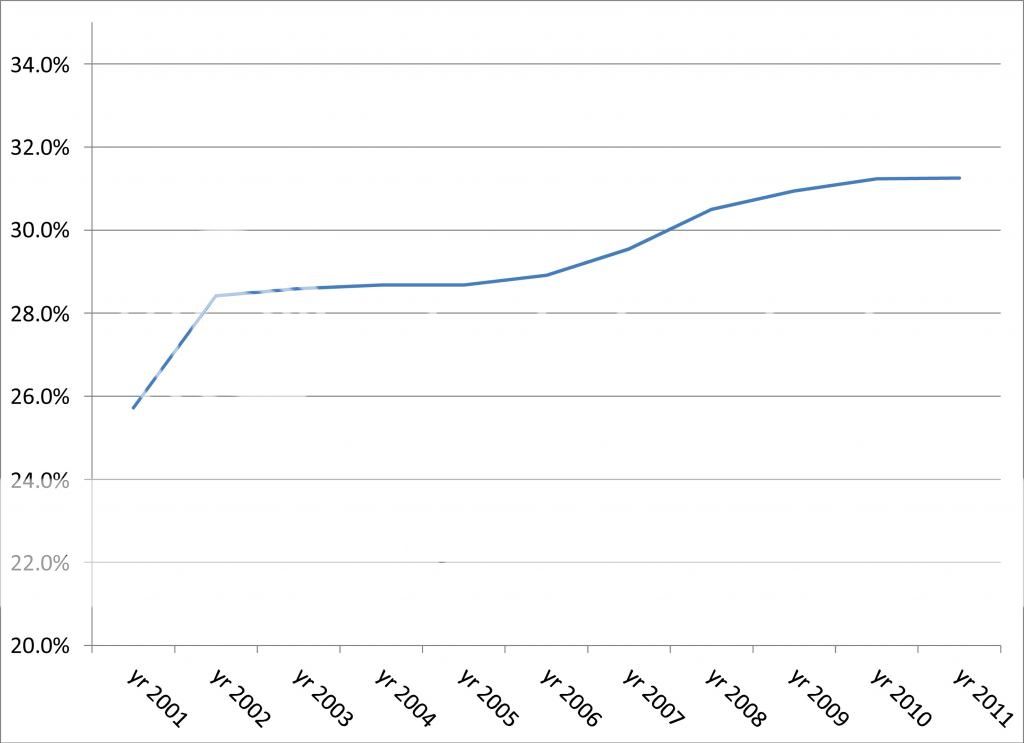
I find it disturbing that the average difference (between median and mean) for all workers in all occupations is as high as 31 percent, especially considering that only 14 occupations have so large a difference. 

I looked at how this difference has changed since 2001, the earliest year for which I was able to obtain mean and median figures for all jobs in all occupations. Here the graph I generated.


You’ll notice that although both lines slope upward with the general modest inflation of wages, the mean increases at a faster rate, causing the gap between them to grow larger. Here is a graph of how that difference changes over those same years.


The present 31 percent difference is yet one more measure of the growing inequality in earnings that marks our present era as another Gilded Age. And, mind you, this difference is based solely on wages and salaries; it does not include the superstar earnings of those who are self-employed or whose earnings are disguised as capital gains.

Wednesday, February 20, 2013

Careers in Standards Enforcement

If you have worked in an industry for some time, you understand the difference between good work and hack work in your field. Perhaps you know harmful results that substandard business practices or products can produce. This knowledge can be the basis of your next job.

Some standards enforcers are essentially cops. They protect the public from illegal acts and harmful products such as hiring discrimination, air pollution, buildings that are firetraps, tainted food products, toxic paint on toys, and defective seatbelts. They conduct inspections, review records, perform tests, and take measurements that indicate compliance with the law or a violation. Like cops, they need to know the fine points of the laws that they are enforcing and the procedures for correcting or punishing those who violate those laws.

Some of these enforcers stay in one setting throughout the workday. For example, some equal opportunity representatives work in the human resources office of a large business and review the company’s hiring and promotion practices by checking records and interviewing staff. Other enforcement workers must travel between sites where they conduct inspections. Environmental compliance inspectors may take air or water samples at various locations; agricultural inspectors may visit several farms or food-processing plants in a workday.

Not all standards enforcers are responsible for upholding the law; some help a business to ensure the quality of its products or services. They make certain that your food will not make you sick, that your car will run properly, and that your pants will not split the first time you wear them. Management does not want to disappoint consumers, especially because news about schlock merchandise can spread quickly through social media and other channels. So quality-control workers sample the output and measure it against industry standards. When they find defects, they determine the cause. And they do more than just prevent substandard output. The current trend in management is to accomplish constant improvement of quality. So quality-control workers devise ways to exceed industry standards.

Maybe you’ve heard the joke about the guy whose job it is to sort potatoes into bags of small, medium, and large spuds. His complaint about the job: “Decisions, decisions!” What makes the joke funny is that the decisions the man must make, though unending, are really of very little consequence; great fortunes are not riding on his ability to make extremely precise judgments about potato size. In real-life jobs, however, enforcement of standards can sometimes have a very large impact. The impact can be beneficial, even life-saving. But it can also create conflict with the company or person whose output you judge as substandard. That’s one reason the decision-making aspect of the job can be stressful. Also, standards enforcers need to make their decisions within a structure of rules and procedures that sometimes can feel arbitrary and confining.

If you’re interested in doing this kind of work, relevant work experience may not be sufficient qualification; some law-enforcement jobs in this field require certification or licensure. Usually you must pass an exam that demonstrates your knowledge of the laws. You will face this requirement especially for jobs that relate to safety, such as construction and building inspectors. For some jobs, however, such as occupational health and safety specialists, licensing is uncommon and certification is voluntary. For these jobs, an appropriate education and work experience are more important.

People work in quality control at all levels, from the low-skilled potato sorters (who can easily be replaced by machines) to quality control systems managers and industrial engineers, who are highly skilled with using statistical techniques to create product-sampling schedules and to make sense of the data derived from them. These workers generally have at least a bachelor’s degree. Several organizations and universities offer graduate-level training that prepares you to pass a certification exam in quality control. Various kinds of science and engineering technicians, often with two-year degrees, support these workers.

There are formal and informal ways to move into standards enforcement. Think about who maintains the quality of output in your current job. Or consider who ensures the safety of your workplace or protects the environment in your community. Ask these people how they got their job and whether your experience in your work role would be helpful background to do this work.

If you’re aware of some aspect of quality control or safety that’s being neglected where you work (or at a similar workplace), maybe you can create a new job for yourself. Prepare a business plan for a program, with you in charge, that will address this need. Be sure to include estimates of the costs and, if possible, the payback to the company from increased sales or the smaller risk of a lawsuit. Then propose this plan to management. If you’re not knowledgeable enough to design and manage a quality control program, maybe you can convince management to bring in an appropriately qualified professional whom you can support as a technician.

Wednesday, February 13, 2013

A New Order in the Court?

The practice of law in America may soon undergo drastic changes. Early this month, the Law School Admissions Council reported that applications for law school were down 20 percent since the same time a year earlier. If this trend continues throughout the application season, the number of applicants will have fallen by 38 percent since 2010. Those who would have applied in previous years are finding other career paths to pursue, turned off by reports of unemployed law-school grads who are unable to pay off the huge debt they have run up in pursuit of the law degree. The American Bar Association found that only 55 percent of 2011 grads had landed full-time, long-term jobs as lawyers nine months after graduation. Only a dozen law schools, out of a total of 198, had a 2011 job-placement rate of better than 80 percent.

It seems likely that the tough job market for new lawyers will continue to get worse as computer technology advances. Computer programs are being used to do much of the research that lawyers used to do; these apps can rapidly chew through reams of documents to retrieve relevant information for purposes such as pre-trial discovery. Many consumers turn to services such as LegalZoom to create routine legal documents such as wills. And some legal research, contract negotiation, and intellectual property services are being offshored to low-wage countries such as India.

In response to this crisis in the profession, the American Bar Association created a task force to recommend changes to the system that educates lawyers, and it’s a measure of the seriousness of the situation that the commission seems likely to issue its report this fall, well in advance of the original deadline of the following summer.

Some of its possible suggestions are already being aired. Prominent among these is the idea of reducing the core of law school to two years from the current three to lessen the tuition debt that law students incur. Another tuition-saving idea is admitting college juniors directly into law school.

Ironically, at the same time that lawyers are not finding jobs, many Americans are having trouble getting legal aid to navigate the courts and have their rights represented. We are all entitled to a defense lawyer in a criminal case, whether or not we can pay for one, but no such public legal help is guaranteed in civil disputes such as evictions, divorce, and child custody cases. The problem is especially acute in immigration courts, where the availability of professional legal help is known to make a huge difference in outcomes.

So perhaps there is merit in one of the most radical ideas being discussed by the ABA task force: the creation of a new occupation, limited-license legal technicians. In practice, these workers would serve a role vis-à-vis lawyers roughly analogous to the role that advanced practice nurses play vis-à-vis physicians.
This occupation already exists in Washington State, where it was created by the state’s Supreme Court this past June. The occupation is regulated by a Limited License Legal Technician Board. The outlines of how the LLLTs are to be educated and what they will be allowed to do are specified in the Supreme Court’s ruling (PDF).

LLLTs will need to hold an associate or bachelor’s degree in an approved paralegal or legal assistant studies program, together with two years of work in this field. Alternatively, candidates for the license may hold a post-baccalaureate certificate from an approved program in the same field, together with three years of work experience. In both entry routes, at least one year of the work experience must be under the supervision of a Washington lawyer, and candidates must practice at least 20 hours of pro bono service in Washington within the two years before they take the licensing exam.

The work LLLTs do will be limited to civil proceedings. It will largely consist of selecting and completing court forms, informing clients of applicable procedures and time lines, reviewing and explaining pleadings, and identifying additional documents that may be needed in a court proceeding. The technicians will not be allowed to represent clients in court or act on the client’s behalf to contact or negotiate with opposing parties.

The amount of pay that LLLTs will earn is not, of course, something that the Supreme Court can specify. The job market will determine this. I’m curious to see whether the cost-benefit tradeoff for entering this occupation will prove more attractive than it presently does for attorneys.

Wednesday, February 6, 2013

In Praise of Mathematics

Mathematics was always my worst subject in school, but the more I learn about the working world, the more I appreciate it. I would advise any young person to study as much math as you can stand, and maybe even a little more. If you can’t stomach calculus, then take statistics. A lot of the really exciting work being done now involves new applications of math. And an ever-increasing number of careers are driven by data, so an understanding of data analysis keeps growing in value.

I remember that in the 1980s Brazil was thirsty for petroleum, so to avoid a gross trade imbalance that nation relied heavily on sugarcane-derived alcohol to power its cars. In 1980 Brazil produced only 182,000 barrels of petroleum. In 2011, however, production from offshore wells had boosted that figure to 2,105,000 barrels. Recently I learned that Brazil has been aware of the existence of offshore oil deposits for decades, but the petroleum is covered by a mile-thick layer of salt, and there used to be no way to determine the right places to drill. What made drilling feasible was the development of new algorithms that could make sense of seismic, magnetic, and gravitational data. In other words, math solved this problem.

Math also plays a role in the development of green energy resources. For example, wind turbines keep getting bigger in order to capture more wind energy, but blades as big as airplane wings create new problems, such as great differences between the wind conditions at the top and bottom of the blades’ sweep. General Electric has found ways to adjust the rotors to these conditions by using sophisticated algorithms that respond to input from various sensors.

“Big data” is another field with a growing need for people with math skills. IBM estimates that every day our economy generates 2.5 quintillion bytes of data, and that 90 percent of the world’s data has been generated in just the past two years. We refer to data analysis casually as “number crunching,” but what does this involve? The most obvious task is summary of large quantities of data. But even this task is multidimensional; you need to find ways to tease out not just the central tendencies, but also measures of variability at any one time and over time. And you have to find ways to ensure the accuracy of the data you’re getting, perhaps by drawing on redundant or divergent sources and finding ways to deal with the contradictions you uncover.

A few weeks ago I blogged about careers in analyzing medical data. The McKinsey Global Institute estimates the potential value of health-care data at more than $300 billion per year, two-thirds of which would result from reducing the nation’s health-care expenditures by about 8 percent. And that is just one field with potential for creating jobs for is big-data analysis. However, McKinsey projects a shortage of 140,000 to 190,000 workers to fill the big-data-crunching jobs that the U.S. economy could generate by 2018.

Over the course of my career, I have learned how to use Excel to do the computational heavy lifting, so it no longer matters that I had a hard time mastering the times tables in elementary school. The math skills I’m learning now are not so much computational as conceptual, such as how and why to use weighted samples. To a young person, I would suggest trying to see beyond computation and focusing instead on the underlying principles of data manipulation and analysis. Those skills can lead to a lifetime career of creative and productive work.