Showing posts with label business models. Show all posts

Thursday, August 7, 2014

A New Skill is Identified: Shopping

Recently I read about a new business, called Instacart, that does your grocery shopping for you. This is different from well-established grocery services, such as Peapod and FreshDirect, because the company owns no food warehouses or trucks, and you don’t have to place your orders many hours in advance. Instead, mere minutes after you place your order on the Web, Instacart enlists someone in your community—an independent contractor, not an employee—to go to one or more existing food stores, buy what you ordered, and deliver it to you in the contractor’s own car.

The shoppers earn between $15 and $30 per hour, depending on how fast they deliver the goods. This is considerably better pay than most jobs at a supermarket, but (like so many work arrangements that the new economy is creating) the work offers no fringe benefits. It is also not likely to provide full-time work, although for some people that’s an advantage.

Instacart makes its profits by charging a flat delivery fee ($3.99 for most orders), plus a markup on the store’s prices. One estimate is that the markup averages about 20 percent.

In some ways, this work arrangement resembles the ride-sharing services Uber and Lyft, in that it uses the Web to match consumers of a service with fairly ordinary people who have that service to offer. One important difference is that the service that Instacart offers—shopping—is not regulated, as taxicab transportation is. Instacart also is unlikely to displace many existing workers, because there are very few professional grocery shoppers, certainly compared to cab drivers.

The work does not require any formal credentials, but it does require a skill that you will probably not find in any existing skill taxonomies: shopping skill. My shopping skill was tested recently when my mother was incapacitated by a hip fracture and I had to buy her groceries. Unlike an Instacart shopper, I was tasked with the additional goal of finding the best prices. As a child of the Depression, my mother knows the going prices of nearly every item she customarily buys at several markets in her Manhattan neighborhood, including the open-air green market in Union Square. Instacart clients don’t require this kind of accountability.

However, Instacart clients do expect speed. This means that the shoppers must know what stores stock a wide range of grocery items and have them in high quality, plus where the items are located in the store. Every year about this time, when summer berries and fruit come ripe, I wander helplessly through the aisles of my local supermarket, trying to find the Sure-Jell pectin for making jams. Is it in the aisle with cooking supplies? Gelatin? Seasonal items? I’m never sure, and even the clerks (if you can find one) sometimes send me to the wrong aisle.

It will be interesting to see whether this kind of work continues to expand beyond ride-sharing and grocery-shopping. Tyler Cowen, an economist at George Mason University, sees the bright side of this trend: “When you ask what kind of niches we’ll see for people who used to be in traditional middle-class jobs, this is the kind of labor that could fit into that. I wouldn’t want to suggest people will become grocery-delivery millionaires, but if you don’t have a college education but you’re smart and responsible, could you make a living doing this and maybe piecing it together with some of these other kinds of jobs? Absolutely.”

I’m not so sanguine about this trend. It reminds me of the old joke that there will always be work because people can do each other’s laundry. That’s true, but as our economy relies more and more on imported manufactured goods, we need to find work that leads to exports.

Wednesday, June 11, 2014

High Tech Also Spawns Small Businesses

Everyone is familiar with gigantic businesses such as Facebook and Amazon that are using Internet technology to create new business models—and therefore new jobs. Just this week, the transportation-alternative app Uber was valued at $18 billion, provoking a flurry of comments from business columnists, some of them thinking the valuation crazy and others thinking it appropriate.

But it’s important to pay attention to small businesses that are springing up as new technologies create opportunities for entrepreneurs who are able to think creatively.

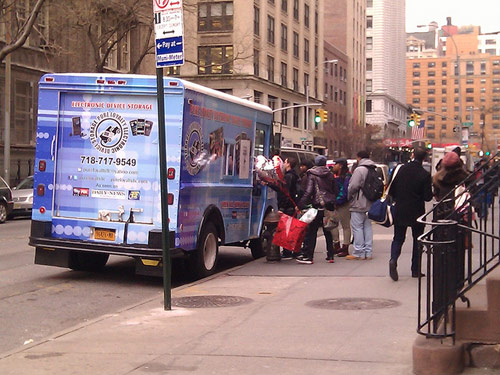
This idea came home to me last week in New York City, as I was walking down 16th Street past the corner of Irving Place, opposite Washington Irving High School. I spotted a parked van with the logo, “Pure Loyalty Electronic Device Storage.” The van was about the size of a food truck and looked very much like this one:


I peeked inside and saw what looked like curtains with pouches sewn on, each labeled with a number. The worker at the window told me that students from the school are not allowed to bring cell phones, tablets, MP3 players, or other electronic devices into the school, so they check them with her each morning (as at a hat-check window) and retrieve them when school lets out. They are happy to pay the dollar-a-day fee rather than be without their devices for as long as it takes them to get to school from home in the morning and back again at day’s end.

According to the New York Daily News, the business was operating trucks in three New York boroughs in 2012 and was founded and owned by 40-year-old Vernon Alcoser, a former correctional officer. That same year, the New York Post estimated that the industry was bringing in $4.2 million per year. In addition to the trucks, some neighborhood grocery stores are offering the storage service as a sideline business.

The industry is not entirely carefree, however. In June 2012, a truck owned by Safe Mobile Storage, parked near Christopher Columbus High School in the Bronx, was attacked by armed bandits, who tied up the workers and took their money, plus 22 cell phones from storage.

Despite such setbacks, the industry seems likely to serve its niche role as long as high schools with metal detectors enforce the citywide ban on electronic devices in the classroom—or until schools provide lockers where students can leave them.

Now that electronic devices have become our constant companions, they are creating countless business opportunities for entrepreneurs who offer to create apps for them, accessorize them, repair them—and store them.